2026
Self-conditioned Flow Map Language Models via Fixed-point Flows
Jaehoon Yoo*, Wonjung Kim*, Floor Eijkelboom, Chanhyuk Lee, Nicholas M. Boffi, Seunghoon Hong†, Jinwoo Kim† (* equal contribution, † equal advising)
COLM NonAR-LM Workshop 2026
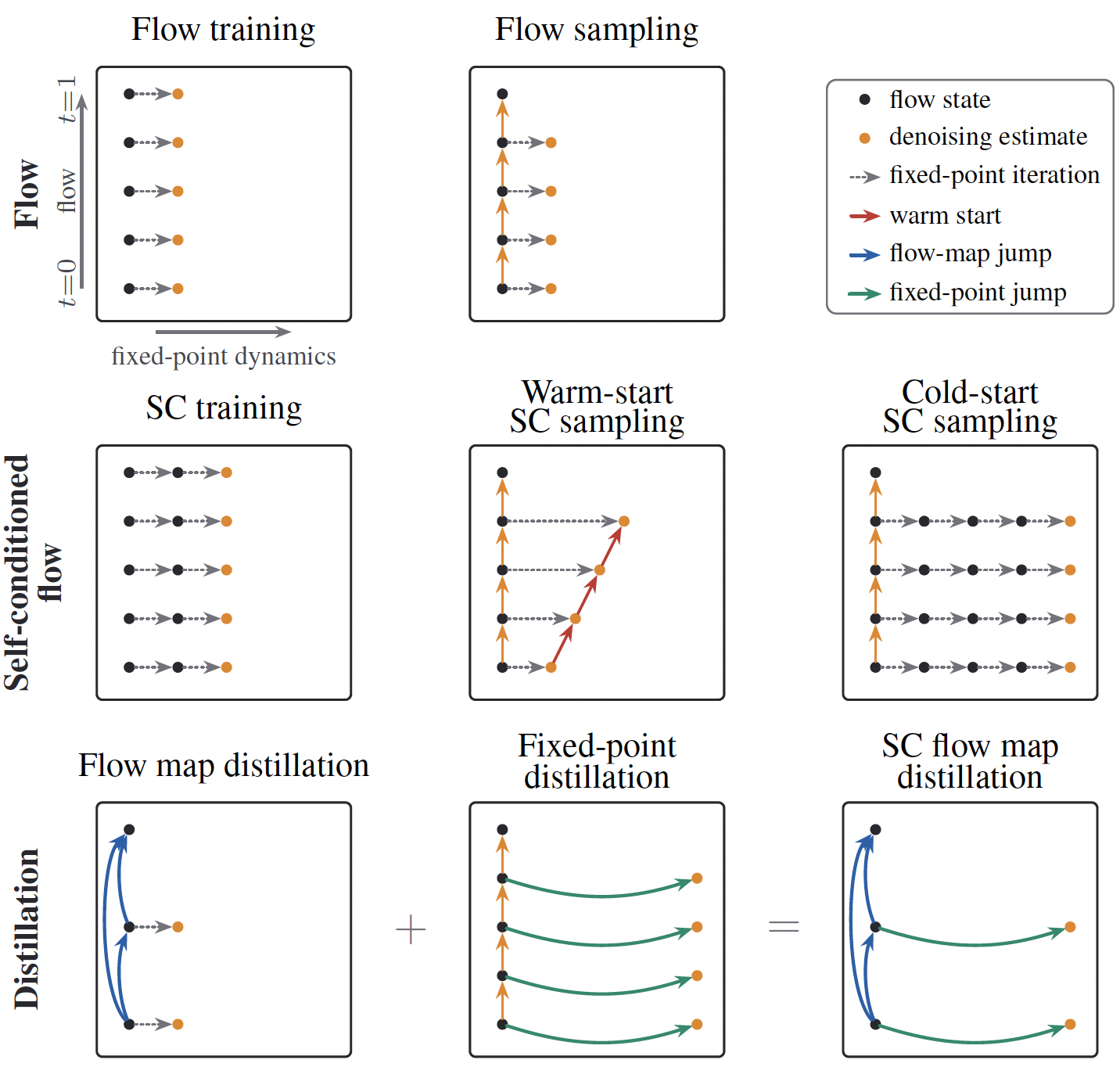
Self-conditioning is a core technique that enhances continuous flow-based language models, where the model learns to denoise generated text by conditioning on its own denoising estimate. While empirically successful, its performance improvements are poorly understood. Moreover, there is growing interest in the use of few-step generators based on flow maps, for which how to leverage self-conditioning is unclear. Here, we show that flow language models with self-conditioning solve a fixed-point iteration that bootstraps the performance of the learned denoiser. We use this viewpoint to formulate fixed-point flows, a two-dimensional class of self-conditioned flows, where the first dimension represents the flow process and the second represents the fixed-point iteration. We show that fixed-point flows define valid flow maps, and show that they can be distilled from self-conditioned flow models by compressing both fixed-point iterations and the flow process, the former with fixed-point distillation and the latter with flow map distillation. Our resulting flow map language model, FMLM⋆, outperforms state-of-the-art self-conditioned models and few-step models in one- and few-step generation on OpenWebText.
Self-conditioned Flow Map Language Models via Fixed-point Flows
Jaehoon Yoo*, Wonjung Kim*, Floor Eijkelboom, Chanhyuk Lee, Nicholas M. Boffi, Seunghoon Hong†, Jinwoo Kim† (* equal contribution, † equal advising)
COLM NonAR-LM Workshop 2026
Self-conditioning is a core technique that enhances continuous flow-based language models, where the model learns to denoise generated text by conditioning on its own denoising estimate. While empirically successful, its performance improvements are poorly understood. Moreover, there is growing interest in the use of few-step generators based on flow maps, for which how to leverage self-conditioning is unclear. Here, we show that flow language models with self-conditioning solve a fixed-point iteration that bootstraps the performance of the learned denoiser. We use this viewpoint to formulate fixed-point flows, a two-dimensional class of self-conditioned flows, where the first dimension represents the flow process and the second represents the fixed-point iteration. We show that fixed-point flows define valid flow maps, and show that they can be distilled from self-conditioned flow models by compressing both fixed-point iterations and the flow process, the former with fixed-point distillation and the latter with flow map distillation. Our resulting flow map language model, FMLM⋆, outperforms state-of-the-art self-conditioned models and few-step models in one- and few-step generation on OpenWebText.
Infinite Mask Diffusion for Few-Step Distillation
Jaehoon Yoo*, Wonjung Kim*, Chanhyuk Lee, Seunghoon Hong (* equal contribution)
ICML 2026
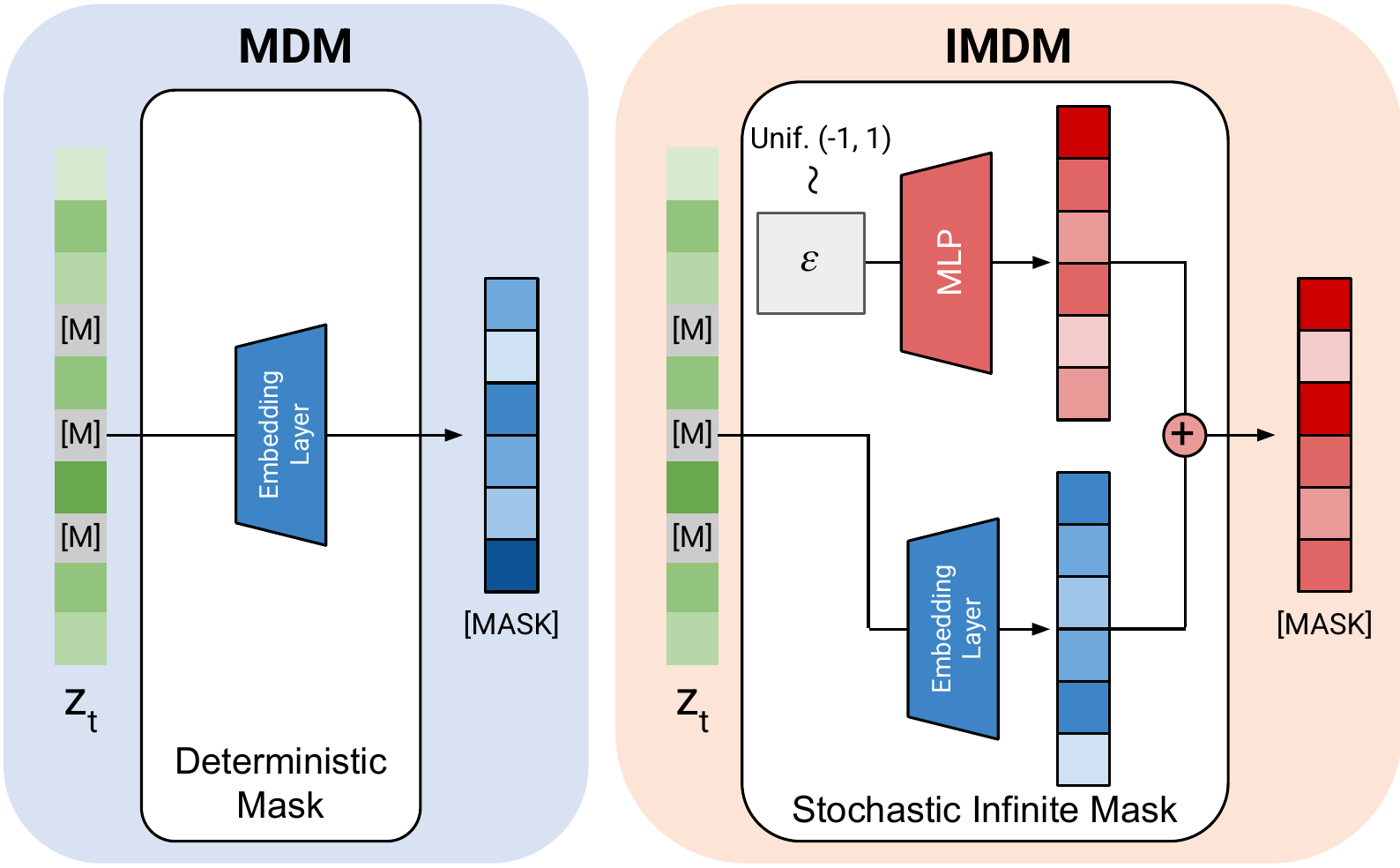
Masked Diffusion Models (MDMs) have emerged as a promising alternative to autoregressive models in language modeling, offering the advantages of parallel decoding and bidirectional context processing within a simple yet effective framework. Specifically, their explicit distinction between masked tokens and data allows their simple framework and effective conditional generation. However, MDMs typically require many sampling iterations due to factorization errors stemming from simultaneous token updates. We observe that a theoretical lower bound of the factorization error exists, which standard MDMs cannot reduce due to their use of a deterministic single-state mask. In this paper, we propose the Infinite Mask Diffusion Model (IMDM), which introduces a stochastic infinite-state mask to mitigate the theoretical bound while directly inheriting the benefits of MDMs, including the compatibility with pre-trained weights. We empirically demonstrate that MDM fails to perform few-step generation even in a simple synthetic task due to the factorization error bound, whereas IMDM can find an efficient solution for the same task. Finally, when equipped with appropriate distillation methods, IMDM surpasses existing few-step distillation methods at small step counts on LM1B and OpenWebText.
Infinite Mask Diffusion for Few-Step Distillation
Jaehoon Yoo*, Wonjung Kim*, Chanhyuk Lee, Seunghoon Hong (* equal contribution)
ICML 2026
Masked Diffusion Models (MDMs) have emerged as a promising alternative to autoregressive models in language modeling, offering the advantages of parallel decoding and bidirectional context processing within a simple yet effective framework. Specifically, their explicit distinction between masked tokens and data allows their simple framework and effective conditional generation. However, MDMs typically require many sampling iterations due to factorization errors stemming from simultaneous token updates. We observe that a theoretical lower bound of the factorization error exists, which standard MDMs cannot reduce due to their use of a deterministic single-state mask. In this paper, we propose the Infinite Mask Diffusion Model (IMDM), which introduces a stochastic infinite-state mask to mitigate the theoretical bound while directly inheriting the benefits of MDMs, including the compatibility with pre-trained weights. We empirically demonstrate that MDM fails to perform few-step generation even in a simple synthetic task due to the factorization error bound, whereas IMDM can find an efficient solution for the same task. Finally, when equipped with appropriate distillation methods, IMDM surpasses existing few-step distillation methods at small step counts on LM1B and OpenWebText.
2025
ReDi: Rectified Discrete Flow
Jaehoon Yoo, Wonjung Kim, Seunghoon Hong
NeurIPS 2025
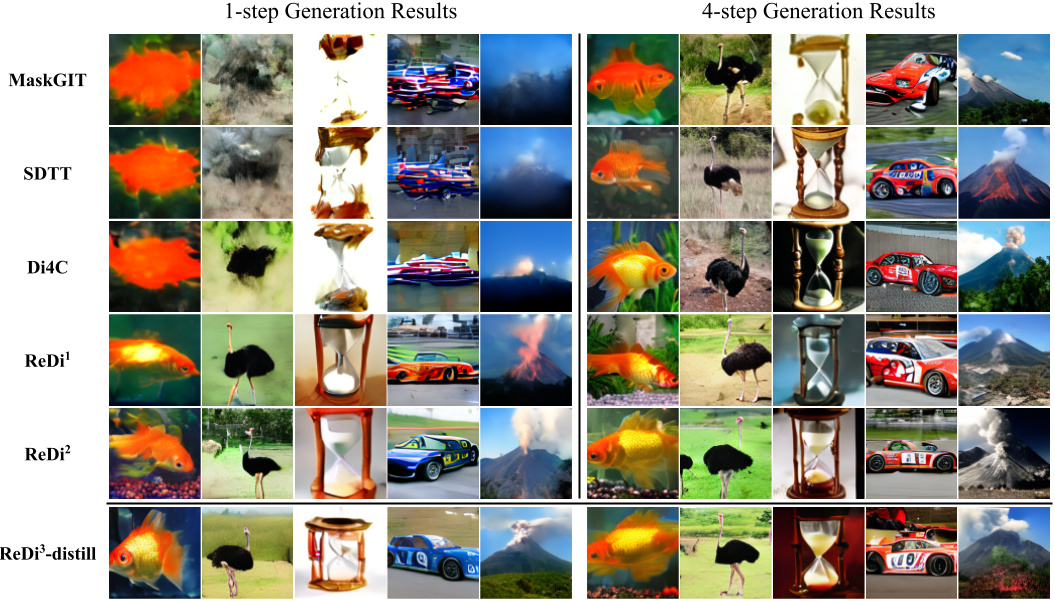
Discrete Flow-based Models (DFMs) are powerful generative models for high-quality discrete data but typically suffer from slow sampling speeds due to their reliance on iterative decoding processes. This reliance on a multi-step process originates from the factorization approximation of DFMs, which is necessary for handling high-dimensional data. In this paper, we analyze the factorization approximation error using Conditional Total Correlation (TC), and reveal its dependence on the coupling. To address the challenge of efficient few-step generation, we propose Rectified Discrete Flow (ReDi), a novel iterative method that reduces the underlying factorization error (measured as Conditional TC) by rectifying the coupling between source and target distributions. We theoretically prove that each ReDi step guarantees a monotonic decreasing Conditional TC, ensuring its convergence. Empirically, ReDi significantly reduces Conditional TC and enables few-step generation. Moreover, we demonstrate that the rectified couplings are well-suited for training efficient one-step models on image generation. ReDi offers a simple and theoretically grounded approach for tackling the few-step challenge, providing a new perspective on efficient discrete data synthesis.
ReDi: Rectified Discrete Flow
Jaehoon Yoo, Wonjung Kim, Seunghoon Hong
NeurIPS 2025
Discrete Flow-based Models (DFMs) are powerful generative models for high-quality discrete data but typically suffer from slow sampling speeds due to their reliance on iterative decoding processes. This reliance on a multi-step process originates from the factorization approximation of DFMs, which is necessary for handling high-dimensional data. In this paper, we analyze the factorization approximation error using Conditional Total Correlation (TC), and reveal its dependence on the coupling. To address the challenge of efficient few-step generation, we propose Rectified Discrete Flow (ReDi), a novel iterative method that reduces the underlying factorization error (measured as Conditional TC) by rectifying the coupling between source and target distributions. We theoretically prove that each ReDi step guarantees a monotonic decreasing Conditional TC, ensuring its convergence. Empirically, ReDi significantly reduces Conditional TC and enables few-step generation. Moreover, we demonstrate that the rectified couplings are well-suited for training efficient one-step models on image generation. ReDi offers a simple and theoretically grounded approach for tackling the few-step challenge, providing a new perspective on efficient discrete data synthesis.